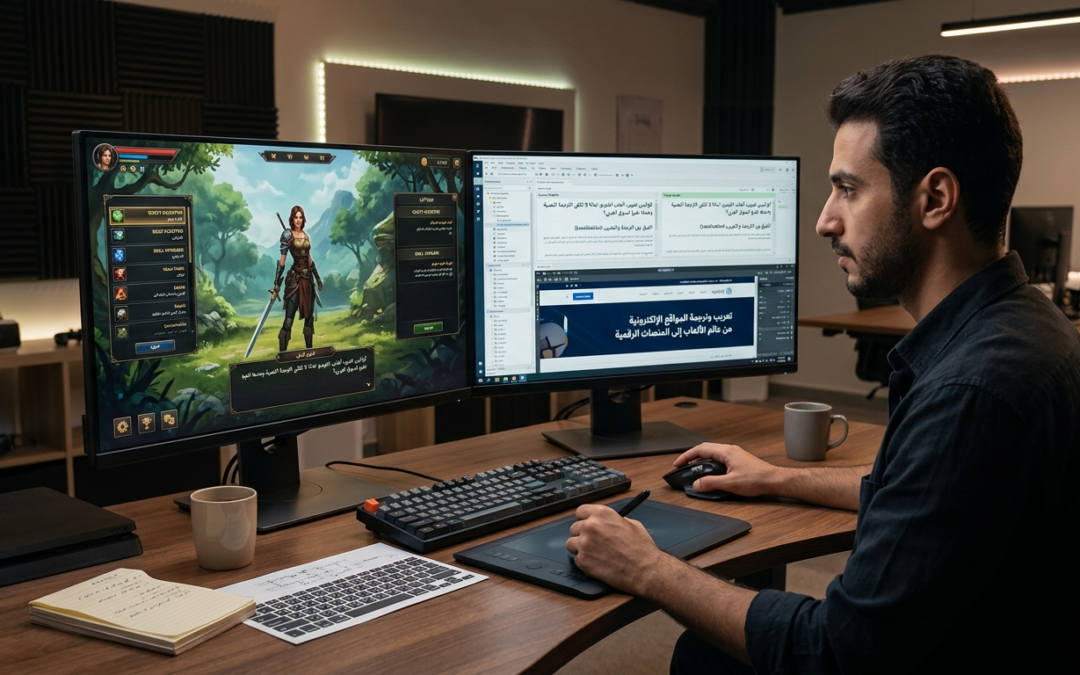
In the last decade, the Arab region has transformed from a mere consumer of games into one of the fastest-growing markets globally. Saudi Arabia, in particular, has become a premier destination for major gaming events and tournaments, significantly boosting the importance of electronic games across the region. But is simply translating your game’s text enough to impress the Arabic player? The truth is, text translation is just the outer shell of a complex technical and creative process known as “Comprehensive Localization.”
We take you behind the scenes of this industry to reveal why video games require skills that go beyond linguistic boundaries, reaching into software engineering and cultural adaptation.
The Difference Between Translation and Localization
First, let’s distinguish between translation and localization. These two concepts are often confused, but in the gaming industry, this distinction determines success or failure:
- Translation: A linguistic process aimed at directly transferring meaning from the source language into Arabic.
- Localization: The process of fully adapting the game technically and artistically. This includes adjusting currencies, time and date formats, measurements, and even modifying symbols and colors to align with the Arabic identity.
- Cultural Adaptation: The deepest level, where game content is audited to ensure it aligns with the religious and societal values of the Arab region. This protects the game from being banned and increases its public acceptance.
Steps in Video Game Translation and the Challenges We Face
Technically, Arabic is classified as one of the most difficult languages in the software field due to its script’s nature. Behind the scenes, engineers and translators face the following challenges:
1. The Right-to-Left (RTL) Writing Dilemma
Most game engines are primarily designed for languages that start from the left. Localizing a game requires:
- User Interface (UI) Mirroring: It’s not enough to just flip the text; sometimes icons, health bars, and menu directions must be relocated to suit the Arabic reader’s eye.
- Font Support: Selecting technical fonts that support the correct “joining” of Arabic letters to avoid the “disconnected letters” issue often seen in low-quality localizations.
2. Text Expansion and Space Constraints
Arabic is an eloquent language, but it can be visually “long.” When translating a short English word into its Arabic equivalent, the character count and occupied space can increase significantly. The localization team is often forced to rephrase sentences multiple times to fit within programmed “text boxes” without text disappearing or overlapping with other elements.
Varieties of the Arabic Language and Selection Methods
There are three main types of Arabic used in electronic game localization:
- Modern Standard Arabic (MSA): The professional and most common choice. It is used in historical or fantasy games and is understood from the Atlantic to the Gulf.
- Spoken Languages (Dialects): Utilized in “street-style” or comedic games to increase realism and appeal to the youth demographic.
- Simplified/Middle Arabic: A blend that simplifies MSA to bring it closer to everyday life; it is frequently used in menus and instructions.
The Review and Testing Phase (LQA)
Before the game reaches the player, it undergoes a rigorous testing phase. During this stage, testers play the game for long hours to:
- Ensure text appears in its correct position within menus.
- Verify that the translation follows the context of events (e.g., ensuring the correct meaning of a homonym was chosen based on what is happening on screen).
- Ensure all buttons and tutorials are clear and do not cause confusion during fast-paced gameplay.
Investment of Translation Companies in Game Localization
Video game localization is more than just translation; it is an investment in breaking the barriers between the developer and the audience. Companies combine a passion for the digital world with linguistic precision to grant your project the identity it deserves in the hearts of Arab players. We invest in localization to help achieve:
- Digital Store Optimization: Global store algorithms prioritize games available in the user’s local language.
- Building a Connected Community: Arab players deeply appreciate companies that respect their language and provide polished content, turning the game into a trending topic on social media.
The Best Website Translation Company in Localization
At Reveal, we believe that digital content is your business’s window to the world. Therefore, we extend our expertise beyond gaming to include Website Localization and Translation. We do not merely transfer words; we technically adapt websites to suit the Arabic user.
Our website localization services include:
- Technical Code Integrity: We guarantee the translation of content while preserving the safety of source codes and scripts (such as HTML and JSON) to ensure the website functions efficiently.
- Content Localization: Crafting digital content in a linguistic style that suits the nature of the web, while adhering to specialized technical terminology.
- Interface Alignment (RTL): Ensuring that Arabic texts appear consistent and visually comfortable within the website’s layout.
All you have to do is contact us to receive the best website localization service in Egypt and the Arab world, delivered with accuracy, professionalism, and speed of execution.